When people ask what style Bob Ross painted in, the short answer is: a mix of landscape realism and alla prima technique, delivered in a highly accessible, teaching-focused format. But that doesn’t fully explain why his work still resonates.
The foundation: landscape realism
At its core, Ross’ work sits within representational landscape painting. He painted mountains, trees, lakes, and skies in a way that’s recognizable and grounded in nature. The compositions often follow familiar structures: a strong foreground, a middle ground, and atmospheric distance in the background.
However, his realism isn’t strict or observational in the academic sense. He wasn’t painting from life in real time. Instead, he worked from a mental library of landscape elements, recombining them into idealized scenes. This is closer to constructed realism than direct observation.
The defining method: alla prima (wet-on-wet)
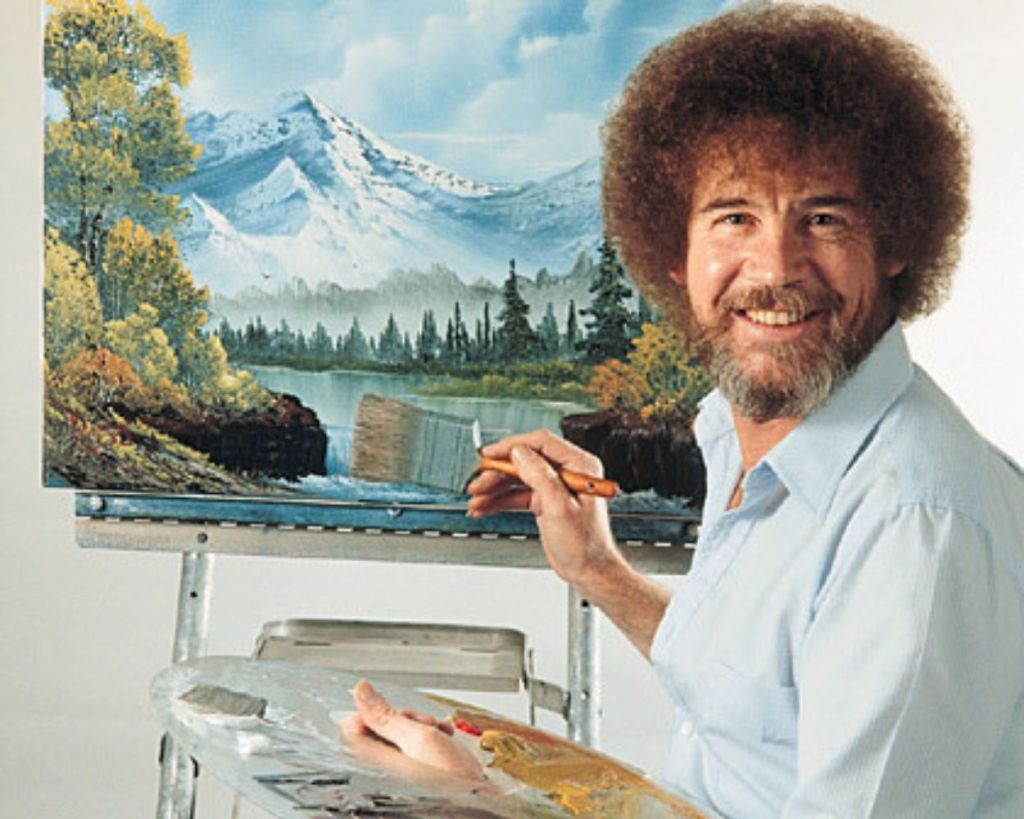
What truly defines his style is the technique. Ross used a wet-on-wet oil method, also known as alla prima, where layers of paint are applied before previous layers have dried. This allows the entire painting to be completed in a single session.
This approach has a long history, but Ross adapted it for speed and clarity. His version is structured for demonstration:
- A thin, wet base layer (often white or light-toned)
- Darker elements laid in quickly
- Highlights added on top with thicker paint
Because the surface stays wet, colors blend directly on the canvas. This is how he achieved soft skies, misty mountains, and quick transitions.
For students, this is important. The technique prioritizes process over correction. You commit to marks and adjust in real time.
Stylization and repetition
Ross’ paintings are highly stylized. Certain motifs repeat: snow-capped mountains, “happy little trees,” reflective water, and soft clouds. These are optimized for the technique.
Each element is designed to be teachable in a short time frame and achievable with limited tools. This repetition often gets criticized, but from a teaching perspective, it’s effective. It builds familiarity and confidence, especially for beginners.
Tools and mark-making
His style is also tied closely to his tools. Ross relied on large brushes, palette knives, and specific loading techniques. Instead of fine detail, he used pressure, angle, and paint thickness to suggest form.
For example, a tree isn’t constructed leaf by leaf. It’s built through repeated, textured marks that imply foliage. This approach reduces complexity without losing visual impact.
Where it sits in art history
Ross’ work isn’t aligned with contemporary fine art movements of his time. It doesn’t engage with conceptual or critical frameworks in the way much late 20th-century art does.
Instead, it sits closer to a tradition of popular landscape painting, combined with mass media education. What makes it significant is not innovation in style, but accessibility. He brought oil painting into everyday spaces and removed much of the intimidation around it.
 Canvas For Painting - Custom Size
Leave a comment